


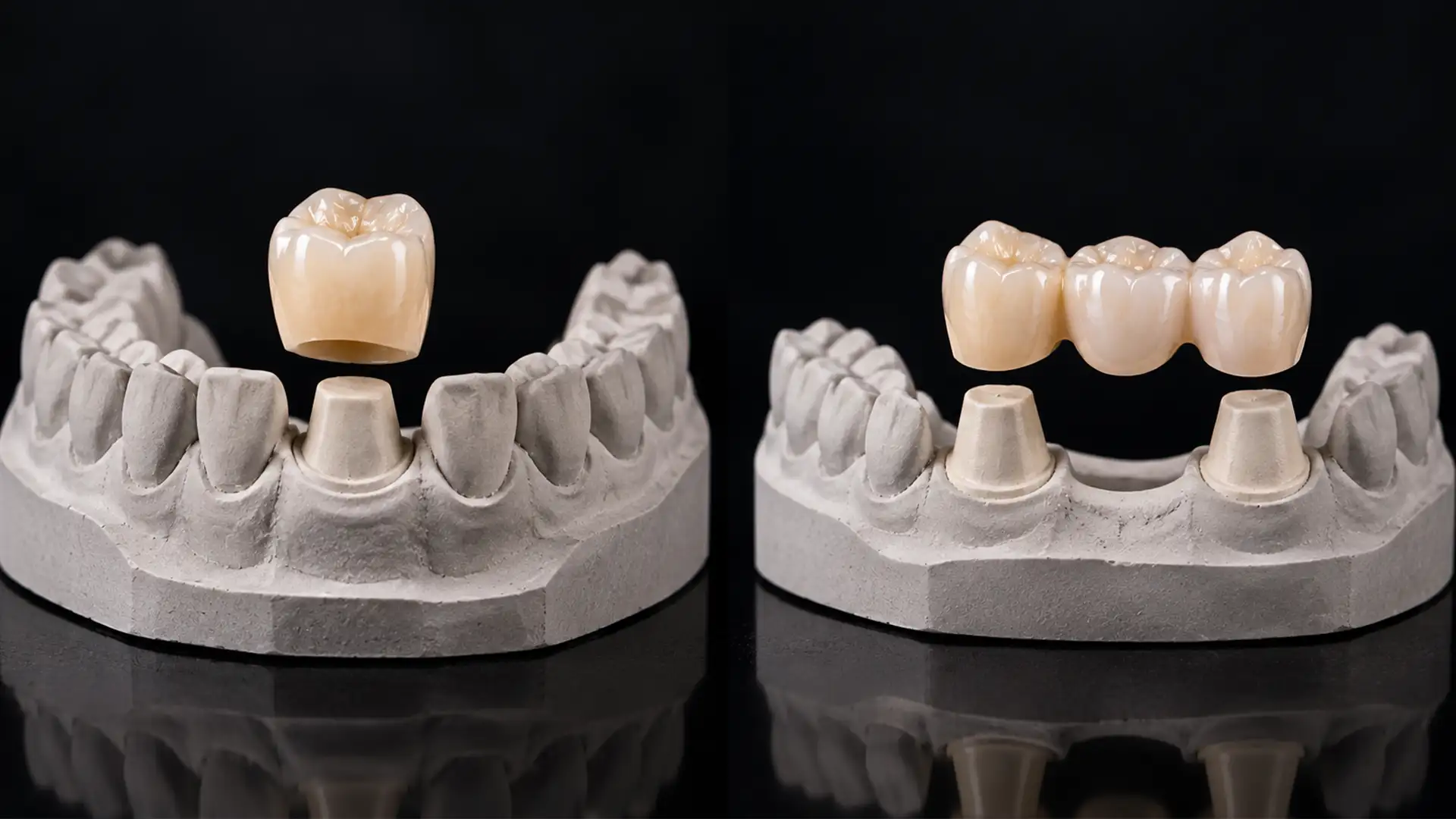
Dental crowns and dental bridges are fixed restorations used to treat damaged or missing teeth. Although they may appear similar, they serve different purposes. A dental crown is used to protect and reshape an existing tooth, while a dental bridge is used to fill the gap created by one or more missing teeth.
Crowns and bridges are among the fixed dental treatments used to address different needs.
What Is a Dental Crown?
A dental crown is a fixed restoration that covers the visible part of a damaged or weakened tooth. Its purpose is to protect the existing tooth while restoring its shape and chewing function.
A crown may be recommended for a tooth with significant tissue loss, a fracture, a large filling or, in some cases, following root canal treatment.
When Is a Dental Crown Recommended?
A crown may be considered when the existing tooth can be preserved but is not strong enough on its own.
In particular, a crown may be planned when:
- A significant amount of tooth structure has been lost.
- The tooth is fractured or has substantial structural damage.
- The tooth has been weakened by a large filling.
- The tooth needs to be strengthened after root canal treatment.
- The shape of the tooth needs to be restored.
In these cases, a dental crown may be considered.
Not every damaged tooth or tooth that has undergone root canal treatment necessarily requires a crown. The amount of healthy tooth structure remaining also plays an important role in the treatment decision.
What Is a Dental Bridge?
A dental bridge is a fixed restoration used to fill the gap left by one or more missing teeth.
Traditional bridges are supported by suitable teeth adjacent to the gap. The artificial tooth or teeth positioned between these supports fill the empty space. The bridge design may vary depending on the number of missing teeth and the condition of the supporting teeth.
When Is a Dental Bridge Recommended?
The primary purpose of bridge treatment is to replace the gap created by a missing tooth with a fixed restoration.
A dental bridge may be considered:
- When a single tooth is missing,
- In suitable cases where several adjacent teeth are missing,
- When the neighbouring teeth are suitable for supporting a bridge,
- In certain cases where implant treatment cannot be performed or is not preferred.
These factors are assessed when determining whether a dental bridge is appropriate.
The health of the supporting teeth and surrounding tissues is important for the long-term success of a dental bridge.
Key Differences Between a Dental Crown and a Bridge
The most important difference between the two treatments is the problem each one is designed to address.
| Feature | Dental Crown | Dental Bridge |
|---|---|---|
| Primary purpose | To restore a damaged tooth | To replace a missing tooth |
| Area of application | Over an existing tooth | In the area of a missing tooth |
| Support | A natural tooth or dental implant | Adjacent teeth or dental implants |
| Structure | May consist of a single crown | May consist of multiple units |
| Reason for use | Fracture, decay or significant loss of tooth structure | One or more missing teeth |
| Cleaning | Similar to normal oral care | The area beneath the bridge requires additional cleaning |
In short, a crown may be considered when a tooth is still present but requires restoration. When a tooth is missing, treatments for missing teeth, such as a dental bridge, may be evaluated.
Dental Crown and Bridge Procedure
Both treatments begin with an evaluation of the teeth and surrounding tissues. X-rays may be taken when necessary, and a treatment plan is created according to the type of restoration required.
- For a dental crown: The existing tooth is prepared to receive the crown. An impression or digital scan is then taken to create a crown that fits the tooth’s shape and bite.
- For a dental bridge: The supporting teeth adjacent to the missing tooth are prepared. An impression or digital scan is then taken to create a bridge that covers the gap and the supporting teeth.
- Temporary restoration: When necessary, a temporary tooth may be used until the permanent crown or bridge is ready.
- Try-in and fixation: The completed restoration is tried in the mouth. Its fit, bite and chewing relationship are checked before any necessary adjustments are made and the restoration is fixed in place.
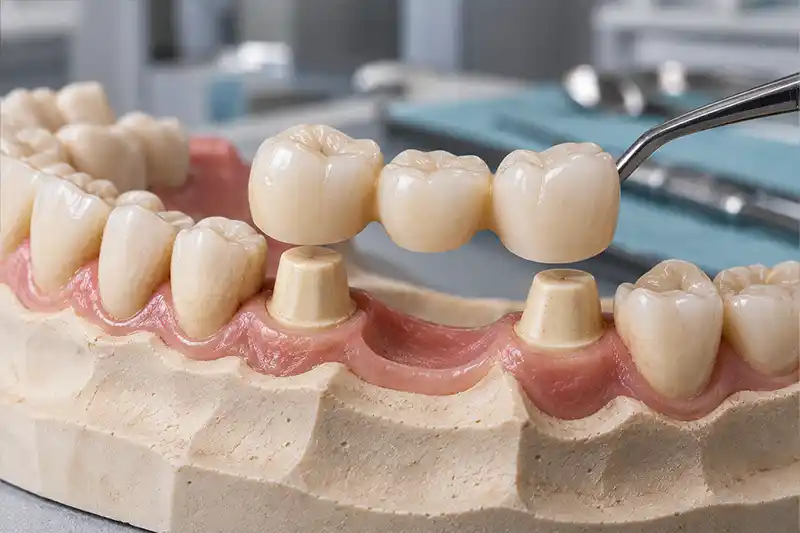
With a traditional bridge, the natural teeth adjacent to the missing tooth must be prepared to provide support. In some cases where preserving these teeth is preferred, a dental implant may be considered as an alternative. The appropriate method is determined according to the condition of the adjacent teeth, the bone structure and the number of missing teeth.
Care and Lifespan of Dental Crowns and Bridges
How long crowns and bridges last depends on several factors, including oral hygiene, the health of the supporting teeth, chewing forces, teeth-grinding habits and regular dental check-ups.
Teeth with crowns should be brushed regularly like natural teeth, and the spaces between them should also be cleaned.
With bridges, cleaning the area beneath the artificial tooth is particularly important. This area can be cleaned using suitable dental floss, interdental products or cleaning tools recommended by the dentist.
Dental Crown and Bridge Treatment in Istanbul
Dental crown and bridge treatment in Istanbul is planned individually according to the condition of the existing teeth and the location of the missing teeth. Before treatment, the teeth and surrounding tissues are evaluated to determine the appropriate crown or bridge restoration.
For patients travelling to Turkey from abroad, a preliminary assessment may be carried out using their existing X-rays and intraoral images. However, the final treatment plan, required procedures and treatment duration can only be confirmed after a clinical examination in Istanbul.
Turk Aesthetic coordinates the process from preliminary assessment to treatment arrangements for local and international patients planning dental treatment in Istanbul. The restoration to be used and the treatment stages are planned according to the patient’s existing dental structure.
Frequently Asked Questions
Are a dental crown and a bridge the same thing?
No. A crown restores an existing tooth, while a bridge is used to fill the gap created by a missing tooth.
Can a bridge be used to replace a single missing tooth?
Yes. If the supporting teeth are suitable, a single missing tooth can be replaced with a bridge. Alternatives such as a dental implant may also be considered.
Are the neighbouring teeth reduced when fitting a bridge?
With traditional tooth-supported bridges, the adjacent supporting teeth must be prepared. Implant-supported restorations are different.
Does a root canal-treated tooth need a crown?
Not every tooth that has undergone root canal treatment requires a crown. The decision is made by evaluating the remaining tooth structure, the tooth’s position and its risk of fracture.
Which is more suitable: a dental bridge or an implant?
This decision depends on the condition of the adjacent teeth and jawbone, the number of missing teeth and the patient’s treatment needs. The same method may not be suitable for every patient.