

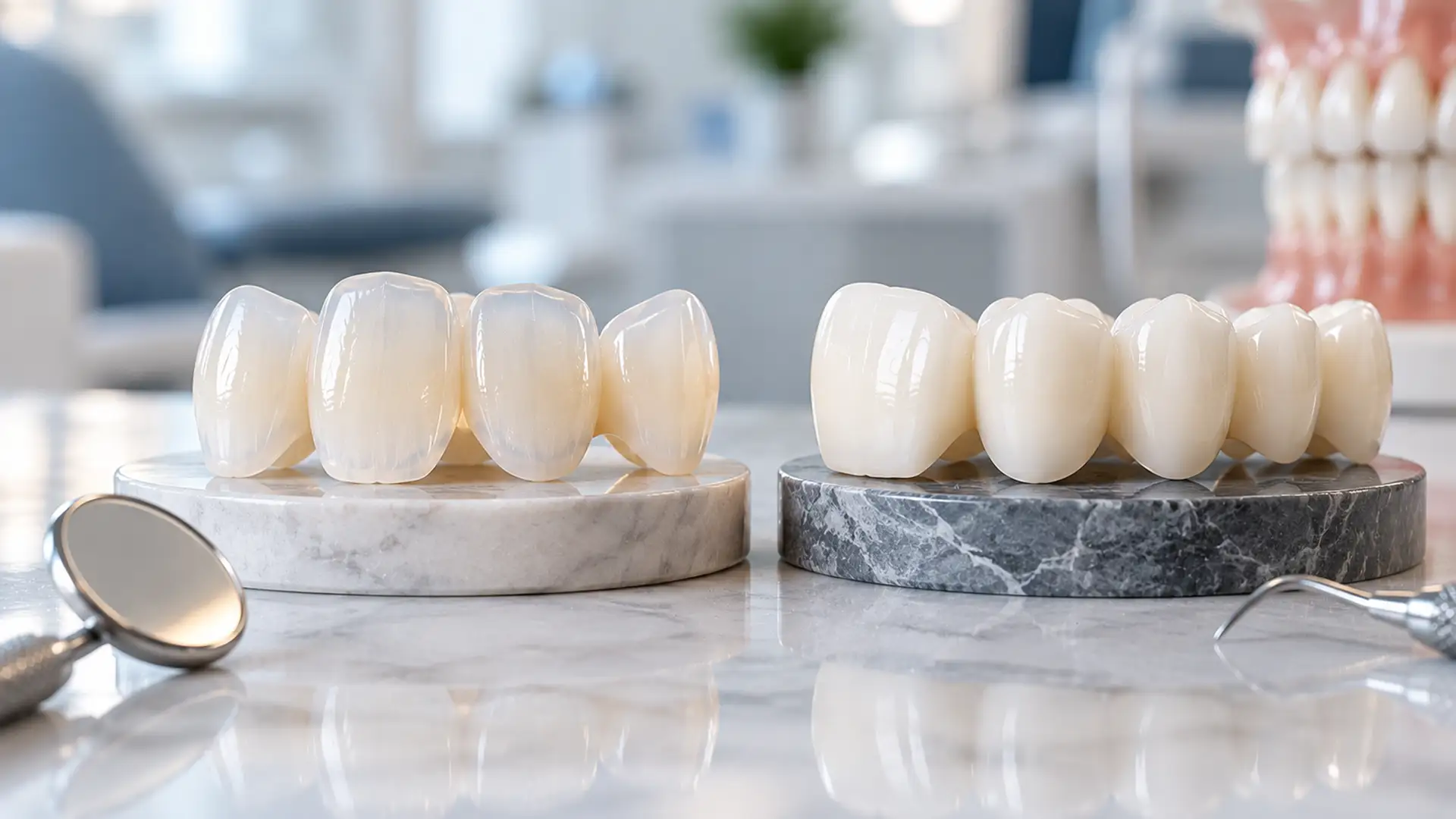
Zirconia and E-max are metal-free ceramic options used in cosmetic dentistry. Both can provide a natural appearance, but they differ in material composition, translucency, and strength.
The answer to “Zirconia or E-max?” therefore depends on the tooth’s location, aesthetic expectations, remaining tooth structure, and chewing forces.
Key Differences Between Zirconia and E-max
| Feature | Zirconia | E-max |
|---|---|---|
| Material | Zirconium dioxide | Lithium disilicate |
| Metal content | Metal-free | Metal-free |
| Translucency | Varies by type | High |
| Strength | Very high | High |
| Front teeth | Can be used | Often preferred |
| Back teeth | Widely used | Assessed on a case-by-case basis |
| Aesthetics | High aesthetic quality | High aesthetic quality, especially for front teeth |
The main difference is that E-max stands out for its aesthetics and translucency, while zirconia stands out for its high mechanical strength. However, this does not mean that E-max should always be used for front teeth or zirconia for back teeth.
Properties of Zirconia and E-max Crowns
Zirconia Crowns
Zirconia is a high-strength ceramic material. The availability of different types allows it to be used for both front and back teeth.
Key features:
- High mechanical strength
- Metal-free composition
- Suitable for use on front and back teeth
- Available in different levels of translucency
- Options suitable for single-tooth and multiple-tooth restorations
E-max Crowns
E-max is a metal-free ceramic material based on lithium disilicate. Its high translucency makes it a frequently considered option for front-tooth restorations, particularly when aesthetic expectations are high. In addition to crowns, it can be used for cosmetic restorations such as dental veneers in suitable cases.
Key features:
- High translucency
- An appearance close to natural teeth
- Metal-free composition
- An excellent aesthetic option, particularly for front teeth
- Can be used for crowns and, in suitable cases, veneers
Aesthetics and Natural Appearance
The translucency of E-max can help recreate natural shade transitions, particularly in front teeth. This makes it a frequently considered option when aesthetic expectations are high.
Newer generations of zirconia also offer improved translucency compared with earlier materials. Zirconia can therefore provide aesthetically pleasing results for front teeth as well.
The following factors are considered together when selecting a material:
- The colour of the natural teeth
- Whether the tooth is at the front or back of the mouth
- The colour of the underlying tooth structure
- The thickness of the restoration
- The patient’s aesthetic expectations
Strength and Applications
Zirconia is often preferred for its high mechanical strength, particularly in areas exposed to greater chewing forces. E-max is also a strong ceramic, but its suitability is assessed according to the location of the restoration.
For front teeth: E-max may be considered when aesthetics and translucency are priorities. Highly translucent zirconia can also be used in suitable cases.
For back teeth: Zirconia is often preferred because chewing forces are higher in this area. The use of E-max is planned according to the tooth’s location and the design of the restoration.
Tooth Preparation and Lifespan
There is no fixed amount of tooth structure that needs to be removed for zirconia or E-max. The extent of preparation may vary depending on whether a crown, veneer, or another type of restoration is planned.
The lifespan of a restoration is not determined by the material alone. The main factors that can affect long-term success include:
- Oral hygiene
- Gum health
- Bite alignment
- Teeth clenching and grinding
- The fit of the restoration
- Regular dental check-ups
When Might Each Material Be Preferred?
To simplify the choice:
E-max may be considered more often:
- When aesthetics are a priority for front teeth
- When high translucency is desired
- When a natural shade match is important for one or a few teeth
- When veneers are planned in suitable cases
Zirconia may be considered more often:
- When high mechanical strength is needed
- When restoring back teeth
- When a restoration involving several teeth is planned
- When aesthetics and strength need to be considered together
Particularly when planning a comprehensive smile design, the assessment includes material selection as well as the shape, colour, alignment, and overall aesthetic harmony of the teeth.
Zirconia and E-max Before and After
In suitable cases, zirconia and E-max can address aesthetic concerns involving the colour, shape, size, and overall appearance of the teeth.
The changes seen before and after treatment may vary from person to person, depending on the original tooth structure, the material used, and the number of restorations placed.
Frequently Asked Questions
Which is better: zirconia or E-max?
There is no single answer for every case. The choice depends on aesthetic expectations, the tooth’s location, chewing forces, and existing tooth structure.
Which looks more natural: E-max or zirconia?
The high translucency of E-max can offer an advantage, particularly for front teeth. However, highly translucent zirconia can also provide natural-looking results.
Which is preferred for front teeth?
E-max is often preferred for front teeth. However, zirconia can also be used depending on the existing tooth colour and the treatment plan.
Which is preferred for back teeth?
Zirconia is a commonly used option for back teeth because of the higher chewing forces in this area.
Which is preferred if you clench your teeth?
If you clench your teeth, bite forces are assessed alongside material selection. Additional measures, such as a night guard, may be planned when needed.
Can E-max and zirconia be used together in the same mouth?
Yes. Both materials can be used within the same treatment plan according to the needs of different teeth.