


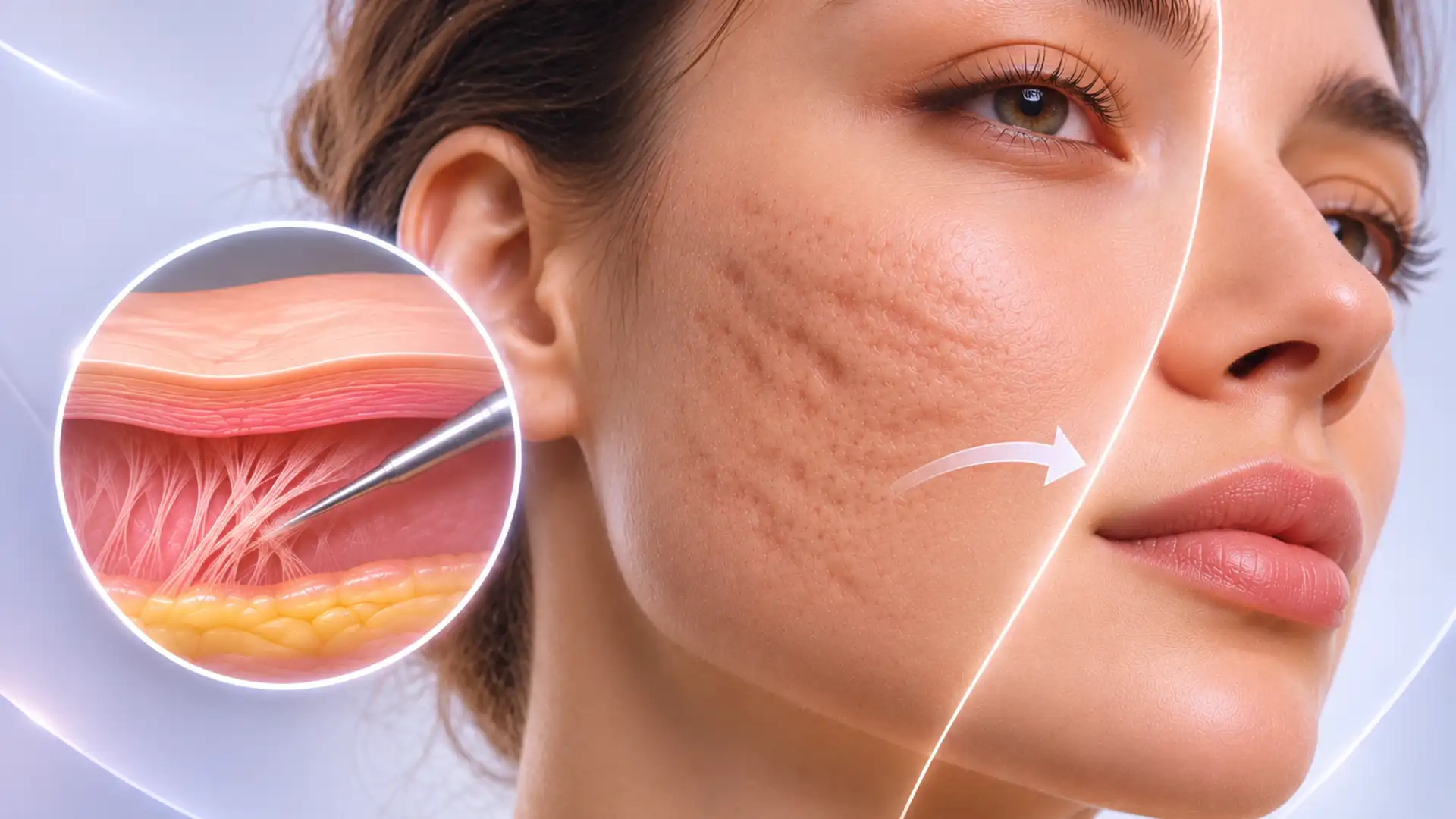
Subcision is a treatment used to release the fibrous bands beneath the skin that pull its surface downward. It is particularly used for depressed acne scars. A special needle or cannula is inserted beneath the skin to release these adhesions, helping the affected area appear smoother.
This technique is especially suitable for rolling acne scars, which create a wave-like appearance on the skin. However, not all depressed scars have the same structure. Suitability is determined by assessing scar depth and the underlying tissue adhesions.
| Treatment Purpose | Release the underlying adhesions that pull depressed acne scars downward |
| Treatment Areas | Primarily the cheeks and other suitable areas with tethered, depressed scars |
| Anesthesia | Usually local anesthesia |
| Procedure Duration | Varies depending on the treatment area and number of scars |
| Number of Sessions | Determined by scar characteristics and treatment response |
| Recovery | Temporary swelling, bruising, and tenderness may occur |
| Results | Assessed as the tissues heal; results vary between individuals |
For detailed information about the treatment process, international patient arrangements, and pricing, see our article on Subcision in Turkey.
What Is Subcision?
Subcision is a minimally invasive procedure that involves mechanically releasing fibrous bands beneath the skin. Older acne scars may contain connective tissue attachments that pull the skin surface downward, creating visible depressions.
Releasing these attachments may help reduce the depressed appearance of scars. The controlled tissue response triggered by the procedure may also support collagen remodeling over time. However, outcomes depend on the scar structure and each person’s healing response.
Which Types of Acne Scars Can Subcision Treat?
Acne scars can develop in different forms. For subcision to be effective, the scar generally needs to be pulled downward by fibrous connective tissue bands beneath the skin.
- Rolling scars: Particularly suitable for assessment when broad, wave-like depressions are tethered to the underlying tissue.
- Some boxcar scars: May be included in the treatment plan for selected depressed scars with significant tethering.
- Other depressed scars: May be considered as an additional treatment in certain cases involving underlying adhesions.
Subcision is generally not the first choice for deep, narrow ice pick scars. Other techniques may be more appropriate for these types of scars.
How Is Subcision Performed?
The procedure is planned according to the characteristics of the acne scars and the size of the treatment area. It is generally performed in four stages.
1. Skin Assessment
First, the type and depth of the depressed acne scars and the underlying adhesions are evaluated. The areas suitable for subcision are then identified.
2. Preparation and Local Anesthesia
The treatment area is cleaned, and local anesthesia is usually administered to minimize pain and discomfort during the procedure.
3. Releasing the Underlying Adhesions
The doctor carefully advances a special needle or cannula beneath the skin to release the fibrous bands pulling the depressed scars downward. This step aims to reduce the tethering responsible for the uneven skin surface.
4. Post-Procedure Assessment
Once the procedure is complete, the treated areas are examined. The patient receives information about possible swelling, bruising, and tenderness, along with instructions for post-treatment care.
Benefits of Subcision
- Can be used particularly for rolling scars tethered to the underlying tissue.
- Directly targets the fibrous bands responsible for depressed scars.
- Can usually be performed under local anesthesia.
- May be combined with other acne scar treatments in suitable patients.
- Tissue healing and collagen remodeling may contribute to gradual improvements in skin appearance.
Who Is a Suitable Candidate?
Subcision may be considered for individuals with depressed acne scars caused by adhesions beneath the skin. Treatment decisions take into account not only the appearance of the scars but also overall skin condition and medical history.
- Individuals with depressed, rolling acne scars.
- Individuals with noticeable skin depressions caused by underlying tissue adhesions.
- Patients whose scar characteristics are considered suitable for subcision.
The procedure may be postponed, or another treatment may be recommended, for individuals with active skin infections, significant inflammatory acne, bleeding disorders, or certain medical conditions that could affect wound healing.
Before Subcision: What to Consider
Before treatment, the condition of the skin and any medications being taken should be reviewed. It is particularly important to inform the doctor about medications that may affect bleeding risk and any previous skin treatments.
- Inform the doctor about all medications and supplements.
- Have any active acne, infection, or skin irritation assessed.
- Provide details of previous laser, filler, or scar treatments.
- Follow the doctor’s recommendations regarding skincare before the procedure.
Do not stop taking prescribed medications, especially blood thinners, without medical advice.
Recovery After Subcision
Swelling, bruising, tenderness, and temporary firmness may develop in the treated area after subcision. These effects usually decrease over time, although recovery varies from person to person.
Changes in the skin during the first few days may not reflect the final outcome. More time may be needed for the tissues to heal and for improvements in scar appearance to be properly assessed.
Aftercare Instructions
- Avoid unnecessary pressure on the treated area during the first few days.
- Follow the doctor’s instructions for cleansing and caring for the skin.
- Ask the doctor how long strenuous exercise and excessive heat exposure should be avoided.
- Protect the skin from sun exposure.
- Seek medical assessment if you experience increasing pain, significant redness, fever, or unusual swelling.
Side Effects and Risks of Subcision
Although subcision is minimally invasive, it involves treatment beneath the skin and may cause certain side effects or complications.
- Temporary swelling, bruising, and tenderness.
- Bleeding or blood accumulation beneath the skin (hematoma).
- Temporary firmness or small nodules.
- Infection or changes in skin pigmentation.
- Rarely, nerve or blood vessel injury, new scarring, or irregular healing.
The level of risk may vary depending on the treatment area, technique used, and individual health conditions. Potential complications should be discussed with the doctor before the procedure.
Subcision vs. Other Acne Scar Treatments
Subcision differs from other scar treatments because it specifically targets adhesions beneath the skin. Techniques such as CO2 Fractional Laser and RF Microneedling support skin renewal through different mechanisms.
| Treatment | Main Purpose | Most Suitable Applications |
|---|---|---|
| Subcision | Release adhesions beneath the skin | Rolling acne scars |
| CO2 Fractional Laser | Support skin renewal and collagen production | Uneven skin texture and selected acne scars |
| RF Microneedling | Support collagen remodeling through controlled microneedling and radiofrequency energy | Selected acne scars and skin texture irregularities |
When multiple types of scars are present, a combination treatment plan may be necessary. The decision to use one technique or combine several approaches depends on the skin assessment.
Frequently Asked Questions
Is subcision painful?
Local anesthesia is usually used. You may feel some pressure during the procedure and temporary tenderness afterward.
Which acne scars respond best to subcision?
It is particularly suitable for depressed, rolling acne scars that are tethered to the underlying tissue.
Does subcision cause bruising?
Yes. Temporary bruising, swelling, and tenderness may occur in the treated area.
How many subcision sessions are needed?
The number of sessions depends on scar depth, extent, and response to treatment.
Can depressed acne scars disappear completely?
Complete removal cannot be guaranteed. The goal is to reduce the depressed appearance of the scars.
When will I see subcision results?
Early changes may be noticeable, but results are better assessed as the tissues heal.
Can subcision be combined with laser treatment?
Yes, in suitable cases. The doctor determines the timing and sequence of treatments.
Are subcision results permanent?
Improvements may be long-lasting, although some scars may become more noticeable again or require additional treatment.