


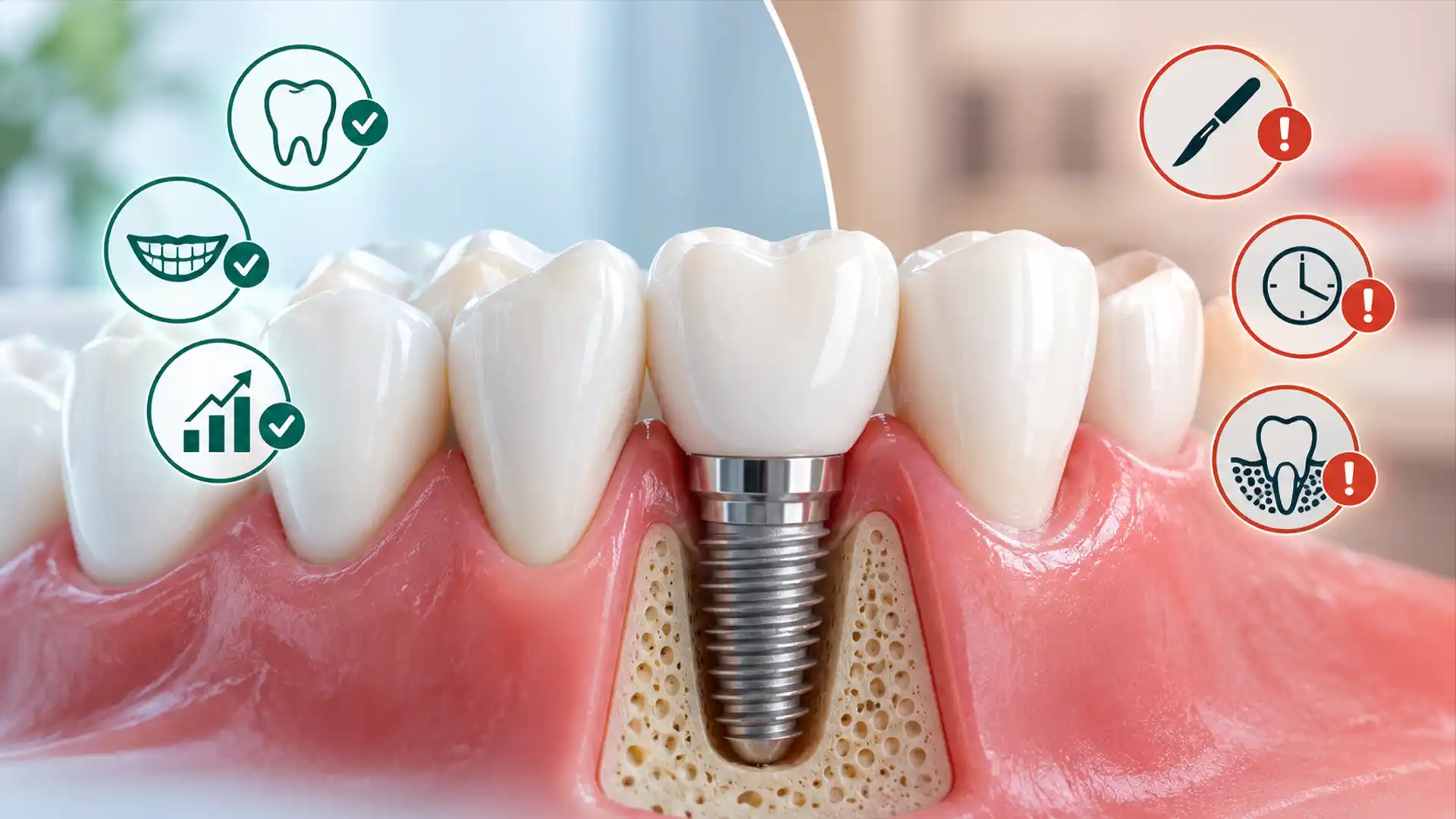
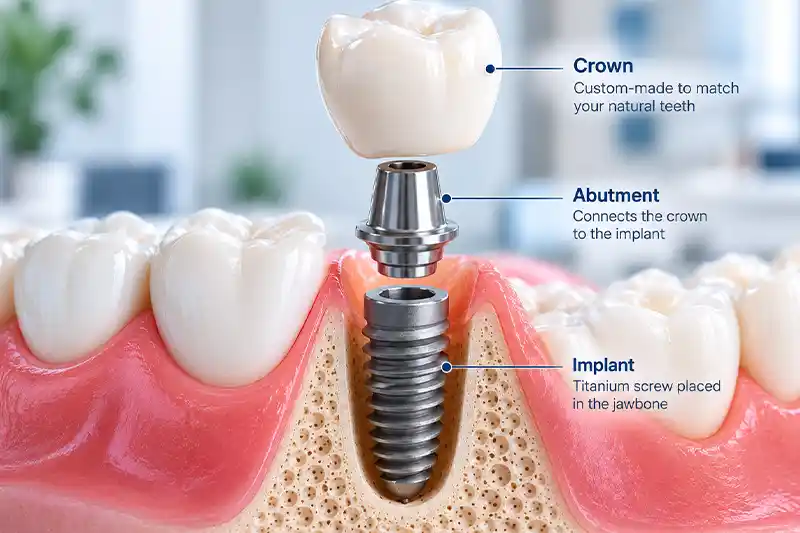
Dental implants are one of the treatment options used to replace missing teeth. An implant is placed into the jawbone to provide support for a crown, bridge, or dental prosthesis. One of its main advantages is the ability to replace a missing tooth without altering the adjacent natural teeth.
However, dental implant treatment does not follow the same process for every patient. There are several factors to consider, including the need for a surgical procedure, the healing period, and sufficient bone structure. For this reason, the pros and cons of dental implants should be considered together before making a treatment decision.
The main advantages of dental implants and the factors that should be considered before treatment can be compared in the table below.
| Consideration | Advantage | What to Consider |
|---|---|---|
| Adjacent teeth | Healthy adjacent teeth usually do not need to be reduced. | Adequate space and suitable bone structure are required for the implant. |
| Chewing | It can help restore chewing function in the area of the missing tooth. | A healing period may be required for the implant to integrate with the bone. |
| Treatment process | It provides independent and fixed support for replacing a missing tooth. | It requires a surgical procedure, and treatment may involve several stages. |
| Bone structure | The implant receives support directly from the jawbone. | Additional bone procedures may be required in some cases where bone volume is insufficient. |
| Longevity | It can last for many years with proper care and regular check-ups. | Longevity can be affected by oral hygiene, surrounding tissues, and individual factors. |
| Maintenance | Fixed restorations can provide function similar to natural teeth. | The gums and tissues surrounding the implant require regular cleaning and care. |
Advantages of Dental Implants
One of the main advantages of dental implants is their ability to provide independent support in the area of a missing tooth. With proper treatment planning and regular oral care, they can also provide a foundation for a fixed restoration designed for long-term use.
- Can preserve adjacent teeth: When replacing a single missing tooth with an implant, healthy adjacent teeth usually do not need to be reduced to support a dental bridge.
- Provides fixed support: Because the implant is placed into the jawbone, it can provide independent support for the restoration placed on top of it.
- Supports chewing function: Proper replacement of a missing tooth can help restore chewing function in the affected area.
- Can provide natural-looking results: The crown placed on the implant can be designed with the shape and color of the surrounding teeth in mind.
- Can be used for different types of tooth loss: Dental implants can be included in various treatment plans, from replacing a single missing tooth or multiple teeth to certain cases of complete tooth loss.
- Can be a long-term option: With proper care, healthy surrounding tissues, and regular check-ups, dental implants can continue to function for many years.
Disadvantages of Dental Implants
Along with the advantages of dental implants, there are also some disadvantages and considerations to be aware of before starting treatment. Their significance can vary depending on the patient’s oral condition and the extent of the treatment required.
- Requires a surgical procedure: Placing a dental implant into the jawbone is a surgical procedure, and a certain healing period is required afterward.
- Treatment can take longer: A waiting period may be required for the implant to integrate with the bone. As a result, treatment may take longer than some conventional dental restorations.
- May not be immediately suitable for every patient: Bone volume, gum health, general health, and certain habits can affect the treatment plan.
- Additional procedures may be required: In some patients with insufficient jawbone, bone grafting or similar additional procedures may need to be included in the treatment plan.
- Requires regular care: Dental implants do not develop cavities, but this does not mean that the surrounding gums and bone require no care. Poor oral hygiene can lead to problems in the tissues around the implant.
What Are the Possible Risks of Dental Implants?
As with other surgical procedures, dental implant treatment involves certain potential risks. Temporary pain, swelling, tenderness, or minor bleeding may occur after the procedure. These symptoms usually decrease as healing progresses.
Less commonly, problems such as infection, insufficient integration of the implant with the bone, or inflammation of the tissues surrounding the implant may occur. Depending on the position of the implant, risks involving nearby anatomical structures are also considered during treatment planning.
For this reason, a clinical examination and the necessary imaging should be performed before implant treatment. Evaluating the bone structure and planning the procedure appropriately are important parts of the treatment process.
Do Dental Implants Damage Natural Teeth?
One of the important features of a dental implant is that it provides its own support in the area of the missing tooth. With a single-tooth implant, the adjacent natural teeth do not need to support the restoration, so they usually do not need to be reduced.
However, the position of the implant, the roots of adjacent teeth, and the surrounding bone structure should be carefully evaluated before treatment. Proper implant positioning is important for the long-term health of both the implant and the neighboring natural teeth.
What Should You Consider Before Getting Dental Implants?
- The amount and structure of bone in the area of the missing tooth should be evaluated.
- Any gum disease or active oral infection should be taken into account when planning treatment.
- Patients should receive information about the implant system that will be used and the restoration that will be placed on it.
- The number of treatment stages and the approximate healing period should be discussed in advance.
- Current medications and existing health conditions should be shared with the dentist.
Patients traveling from abroad for treatment can find more detailed information about dental implants in Turkey, treatment planning in Istanbul, and prices on our dedicated page.
How Should the Pros and Cons of Dental Implants Be Evaluated?
The main advantages of dental implants include providing support independently of adjacent teeth, being suitable for different types of tooth loss, and providing a foundation for fixed dental restorations. On the other hand, the need for surgery, the healing period, and the possibility of additional procedures in some patients are important factors to consider.
Rather than making a decision based only on the advantages or disadvantages, the area of the missing tooth, adjacent teeth, bone structure, and overall oral health should be evaluated together to create an appropriate treatment plan for each patient.
Frequently Asked Questions
What is the main advantage of dental implants?
One of the main advantages of dental implants is their ability to provide independent support in the area of a missing tooth. This means that, particularly when replacing a single tooth, healthy adjacent teeth may not need to be prepared to support a dental bridge.
What are the disadvantages of dental implants?
The main disadvantages include the need for a surgical procedure, a certain healing period, and the possibility that additional procedures such as bone grafting may be required in some patients.
Can dental implants fail?
Yes. Successful integration of every implant with the bone cannot be guaranteed. Bone structure, oral hygiene, smoking, certain health conditions, and post-treatment care can affect the outcome.
Which is more suitable: a dental implant or a dental bridge?
The choice depends on the condition of the adjacent teeth, the jawbone, the number of missing teeth, and the overall treatment plan. A traditional dental bridge receives support from neighboring teeth, while an implant can provide independent support in the area of the missing tooth.
How long can dental implants last?
Dental implants can last for many years with proper care and healthy surrounding tissues. However, there is no fixed lifespan that applies to everyone. Oral hygiene, bone and gum health, personal habits, and regular check-ups can affect their longevity.
Who may not be suitable for dental implants?
Active gum disease, insufficient bone structure, certain uncontrolled systemic conditions, or factors that can interfere with healing may affect the treatment plan. Suitability for dental implants is determined after a clinical evaluation.